
Principal Investigator: Dr. Lourdes Cardozo Gaibisso
International Partners: Natalia Zambon Ferronato, Universidad ORT Uruguay, Uruguay.
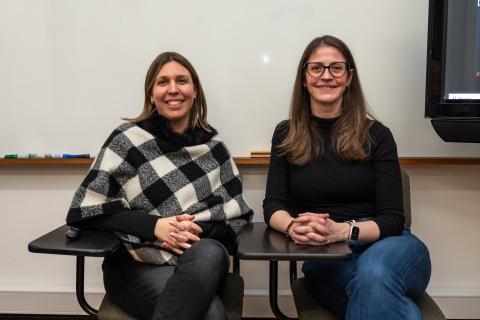
TESOL Professional Development session in June 2025 (Uruguay)
Led by Dr. Lourdes Cardozo Gaibisso, this project launched a cross-national professional development model designed to strengthen English language instruction in both Mississippi and Uruguay.
BRIDGE TESOL, short for Building Regional Initiatives for Developing Global Educators for Teaching English to Speakers of Other Languages, aimed to address critical shortages of ESOL in-service teachers and the professional isolation many educators experience in their local contexts. Built in partnership with Universidad ORT Uruguay, the project blended in-person workshops, virtual Communities of Inquiry, and transnational collaboration to create a scalable, theoretically grounded approach to ESOL teacher professional learning. “ESOL Teachers are often doing the best they can within very complex systems,” Cardozo Gaibisso said. “We wanted to build a professional space where they felt connected, supported, and grounded in strong pedagogical principles, regardless of whether they were teaching in Uruguay or in Mississippi.”
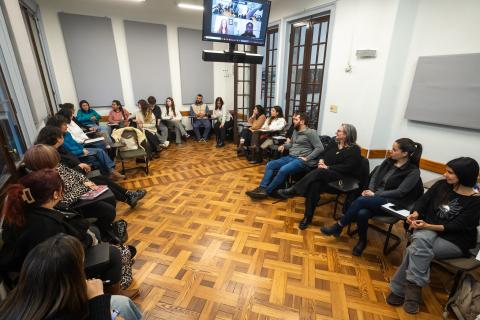
session
While the grant proposal anticipated providing in-service teacher professional learning for 10 Uruguayan teachers, the first cohort grew to 22 ESOL educators, all of whom completed multi-session workshops co-facilitated by Cardozo Gaibisso and co-PI Natalia Zambon Ferronato at ORT. Teachers from Starkville and surrounding districts later joined the U.S. cohort, participating in an in-person session at MSU and engaging in shared online learning and collaboration with their Uruguayan peers.
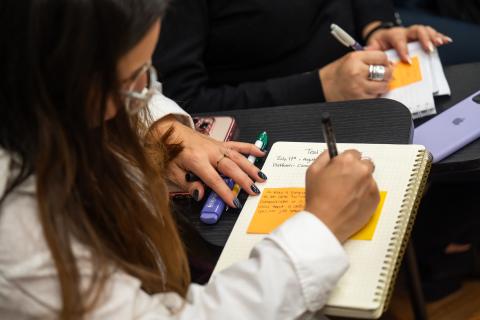
session
Across both countries, the program emphasized key pillars of effective professional learning: collaboration, sustained engagement, teacher agency, reflective practice, and strong ties between theory and classroom reality. Teachers described feeling “less alone,” “more confident,” and newly connected to a professional community; findings echoed throughout the program’s qualitative data. A recurring theme was the role of place-based learning, with teachers drawing on students’ lived experiences, communities, and cultures to make English teaching and learning more meaningful.
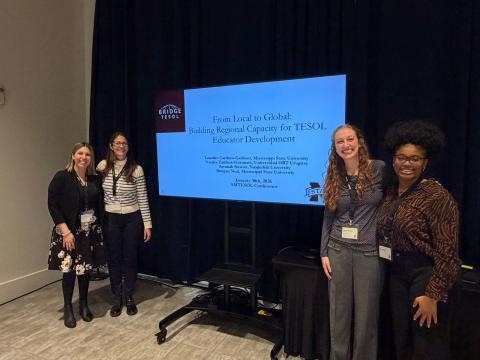
Stewart and Morgan Neal presenting the project at the Alabama–Mississippi TESOL
Conference, January 2026
By the project’s conclusion in December 2025, BRIDGE TESOL had produced significant scholarly and professional outputs, including:
- A peer-reviewed article on sustainable ESOL teacher development strategies
- An accepted book chapter on ESOL teacher well-being in Uruguay
- An AMTESOL conference presentation co-delivered by the U.S. and Uruguay team
- A fully developed Canvas-based professional development platform and data collection system
- The project also earned approval for Continuing Education Units (CEUs), allowing Mississippi teachers to receive formal credit for participation. In Uruguay, teachers received certificates of completion.
Project Impact
Publications:
Cardozo Gaibisso, L. (2025). Sustainable Strategies in ESOL Teacher Development: Connecting Theory, Practice, and Community. Cuadernos De Investigación Educativa, 16. https://doi.org/10.18861/cied.2025.16.especial.4226
Cardozo-Gaibisso, L., Zambon Ferronato, N., Stewart, S., & Neal, M. ESOL teacher well-being in Uruguay: Insights from an international professional development program. In M. M. Olivero (Ed.), English language teacher wellbeing in Latin America. Multilingual Matters. Proposal accepted, chapter under preparation.
Conference Presentation:
Cardozo Gaibisso, L., Zambon Ferronato, N., Stewart, S. & Neal, M. (2026). From Local to Global: Building Regional Capacity for TESOL Educator Development. To be Presented at the Alabama-Mississippi TESOL (AMTESOL) Conference. Flowood, MS.